
Let's talk about the part everyone dreads
You want to bring your lemon clitoral vibrator into sex with a new partner, but you're stuck on one question: how do I even start this conversation without making it weird? Here's what I tell my clients: the awkwardness isn't about the toy. It's about the silence around it.
Once you break that silence, everything else becomes logistics. And logistics are easy.
The difference between introducing early and introducing later
Timing matters more than you'd think, and not for the reason you might assume. It's not that earlier is always better or later is safer. It's that the energy around the introduction changes based on where you are in the relationship.
If you're still in that honeymoon phase (first four to eight weeks), bringing up a lemon vibrator or any clitoral vibrator can actually feel lighter. Everything is still new, curiosity is high, and there's less baggage around what sex "should" look like between you two. You haven't locked into patterns yet.
If you're deeper in (three months, six months, a year), the introduction has different weight. He or she might wonder why you're bringing this up now. "Is something missing? Are you not satisfied?" Those questions aren't unreasonable, but they require a different conversation.
Neither timeline is wrong. Both require honesty, but the frame changes. Early introductions are about invitation and discovery. Later introductions are about evolution and deepening.
The actual conversation: what to say
Forget scripting. Scripts sound false. Instead, anchor yourself in three truths and let them guide your words.
Truth one: this is about addition, not correction. You're not saying "I need this because sex with you isn't working." You're saying "I think we could both enjoy this together." That's a fundamentally different message. Lemon vibrators, clitoral vibrators, any toy—they're not fixes. They're tools that can add sensation, novelty, and sometimes bring people closer.
Truth two: you've thought about this beforehand. Don't spring it on him or her in the moment. That reads as impulsive or like you've been hiding something. A calm, out-of-bed conversation (maybe over coffee, maybe walking) signals that this is something you've genuinely considered, not just a whim.
Truth three: you're inviting his or her input. "I've been curious about trying a lemon clitoral vibrator together. What do you think about that?" is wildly different from "I want to use this." One opens a dialogue. One announces a decision. The dialogue is where trust lives.
What to expect as a response
Most new partners fall into one of four buckets, and knowing which one you're dealing with makes the next steps much clearer.
Bucket one: enthusiastic. "Yeah, let's try it!" These people are generally curious, sexually confident, or both. No further convincing needed. Move to the logistics section below.
Bucket two: cautious-but-open. "I'm not sure, but I'm willing to try it." This person needs reassurance, not pressure. Offer to let them hold it, look at it, understand how it works before anything happens. Demystifying takes fear out of the equation.
Bucket three: hesitant or worried. "I don't know, does that mean I'm not enough?" This is the bucket that requires the most honesty and gentleness. He or she is equating your pleasure device with their adequacy, which is a common fear. Address it directly: "You are enough. This isn't about you. It's about what feels good to my body, and I want you there while I explore that."
Bucket four: no, not interested. Some people have a hard boundary against toys. If it's a dealbreaker for you, that's worth knowing now. But often, it's not a permanent no. It's a "not yet." You can circle back in a few months. Don't make this the thing that defines the relationship unless you're sure it needs to.
How to actually introduce the toy
First time using a lemon vibrator or any clitoral vibrator with a partner requires preparation that has nothing to do with the mechanics.
Set the scene without making it a production. Clean sheets, maybe dim lighting, the space you'd normally have sex in. This isn't a clinical demonstration. It's foreplay. Treat it like foreplay.
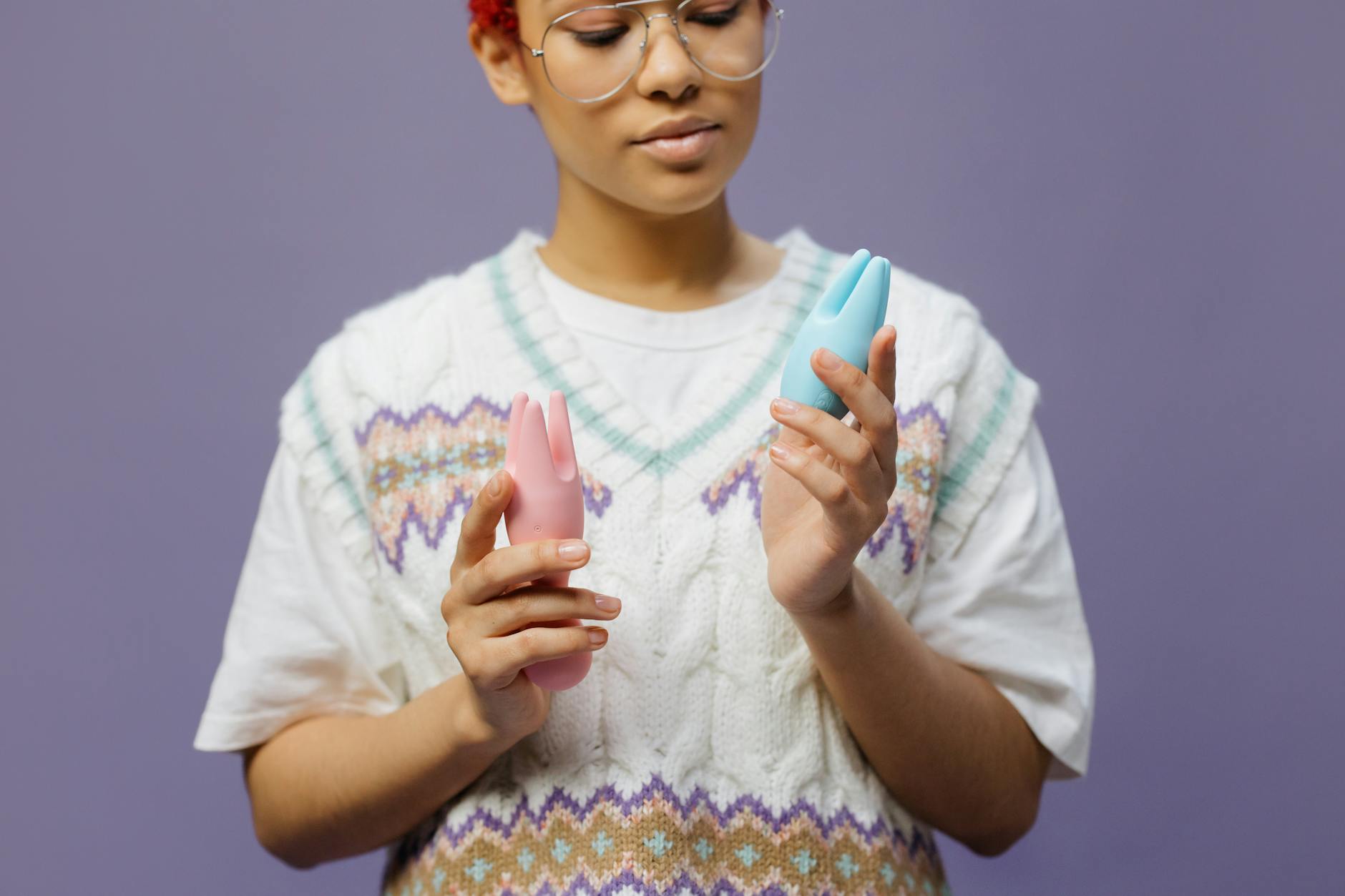
Photo by cottonbro studio on Pexels
Start without the toy. Kiss, touch, build arousal the way you normally do. Then introduce it casually. "I want to show you something." Or "I'm going to try this now." Hand it to him or her if they want to hold it. Let them turn it on. Let them see how it feels in their hand. Demystification is your friend here.
When you do use it, guide your partner on what feels good. "A little higher," "Slower," "More pressure." Communication during sex with a new partner is already important; a toy just makes it more obvious that communication is happening. That's actually a gift.
If you're using a toy like the Lem, which is a suction-based lemon clitoral vibrator, your partner might need a moment to understand how it works. It's not a vibrator in the traditional sense. It creates a gentle suction around the clitoris. Once they see the difference in your response, understanding clicks into place.
The psychological piece nobody talks about
Introducing any tool—whether it's a lemon sucker, a vibrator, or anything else—into partnered sex can actually deepen intimacy if you let it. Here's why: you're inviting him or her into your pleasure. You're being vulnerable about what works for your body. You're asking for collaboration instead of performance.
That's intimate.
Some of my clients find that toys become a shorthand for communication. "Do you want the Lem tonight?" becomes a conversation starter. It removes shame and adds playfulness. Other couples find that introducing a toy actually helps them learn more about each other's bodies because the toy creates space for conversation that might not happen otherwise.
There's also something worth knowing: for women and people with vulvas, clitoral vibrators can make orgasms more reliable and more frequent in partnered sex. If that's the case for you, your partner might notice that you're more satisfied, more present, more engaged. Some partners feel relief about that. Others feel a mix of relief and curiosity. That's all normal.
What if it doesn't feel good in the moment
Okay, so you've had the conversation. He or she is game. You've set the scene. And then... it just doesn't feel right. Maybe the angle is off. Maybe the timing feels forced. Maybe you're in your head.
Stop. Just stop and say so.
"This isn't working for me tonight. Can we just be together the regular way?" You don't need a reason. You don't need to apologize. And you absolutely don't need to make your partner feel like they did something wrong. Toys don't work every time. Neither does traditional sex. That's just bodies.
Try again another time if you want to. Or don't. There's no obligation to make the lemon clitoral vibrator a permanent fixture in your sexual life just because you introduced it. You were curious, you tried it, and now you know. That's data.
The longer-term rhythm
Once you've introduced the toy and you both know it works for you, the question becomes: how often? Every time? Sometimes? Only when you ask for it?
There's no rule. The best couples I work with treat toys like they treat any other sexual preference: communicated, flexible, and responsive to what both people want that day.
Some couples find that lemon vibrators or other clitoral vibrators become a regular part of their sexual repertoire. Others use them occasionally. Some people want them only during certain kinds of sex. The relationship to the toy evolves, just like everything else does.
What matters is that you keep talking about it. "Did that feel good for you?" "Do you want to use it again?" "Are there things we could do differently?" These aren't awkward follow-ups. They're the conversations that keep intimacy alive.
People also ask
Will using a toy like the Lem with my partner make me dependent on it for orgasms?
No. Your body doesn't become "dependent" on pleasure. If anything, clitoral vibrators help you learn what sensations work best for you, which you can then communicate to your partner. Some people who use toys during partnered sex find they're actually more orgasmic with their partner overall because the barrier between "what feels good" and "how to communicate that" disappears. The toy is a tool for information, not a crutch.
What if my partner wants to use the lemon clitoral vibrator on me but I'm nervous about losing control?
Control is the real issue here, not the toy. Talk about what makes you nervous. Is it vulnerability? Physical sensation? Trust? Once you name it, you can address it. Maybe you guide his or her hand. Maybe you hold the toy yourself while he or she touches you elsewhere. Maybe you practice in a low-pressure scenario first. Control can be shared.
Can we use a lemon vibrator if we're trying to conceive?
Yes, absolutely. Vibrators and sexual pleasure don't interfere with conception. Orgasms might even help with conception in some cases, though the evidence is mixed. If you're trying to get pregnant, the conversation is separate from the pleasure conversation. They can both happen.
Is it weird if my new partner suggests bringing a toy into our sex before I do?
Not weird at all. Some people are more comfortable initiating this conversation than others. If he or she brings it up, you're off the hook for the hard conversation. You can be honest about whether you're interested. No obligation either way.
How do I know if the lemon sucker or another clitoral vibrator is even going to work for me and my partner?
You don't know until you try. That's the whole point. You can read reviews, watch videos, get recommendations. But bodies are individual. What works for someone else might not work for you. That's why communication during the experience matters more than the specific toy. The feedback you give tells you both what to explore next.
What if we use the toy once and then my partner never wants to again?
That's fine. People change their minds. Circumstances change. Interest waxes and wanes. You tried something together, you got data about what you both enjoy, and you move forward from there. The goal isn't to convince your partner to love toys. The goal is to have honest sex with the person you're with.
Introducing a lemon clitoral vibrator to a new partner is less about the toy and more about practicing honest, curious communication. The toy is just the vehicle. If you can talk about pleasure openly with this person, the conversation will likely extend to other parts of your life together. And that's the real win.